
I must confess, I love jewelry. While walking past window displays and open markets, I’m like a magpie attracted to anything colorful, glittery, or shimmering — I can’t help but stop and look. Sure, earrings and bracelets make great souvenirs since they’re small and easy to pack. But let’s be honest here, I’m just using that as an excuse for a pretty purchase.
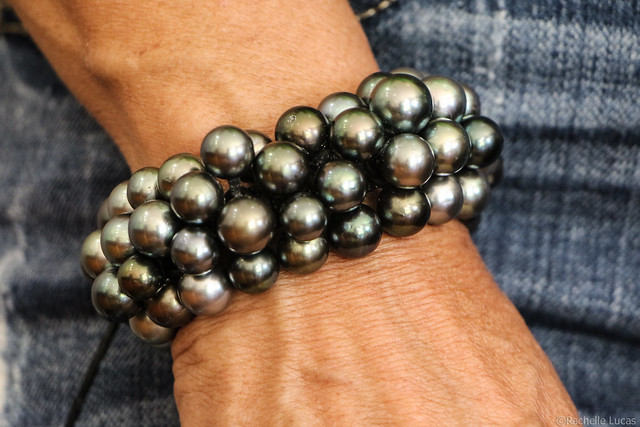
While in Bora Bora on assignment for the Four Seasons Private Jet Experience, the lustre of Bora Bora’s black pearls lured me in. It’s hard not to find their dark iridescence intriguing. White pearls are certainly a classic, but their grayish silver cousin makes the fresh water pearls seem uptight and conservative by comparison.
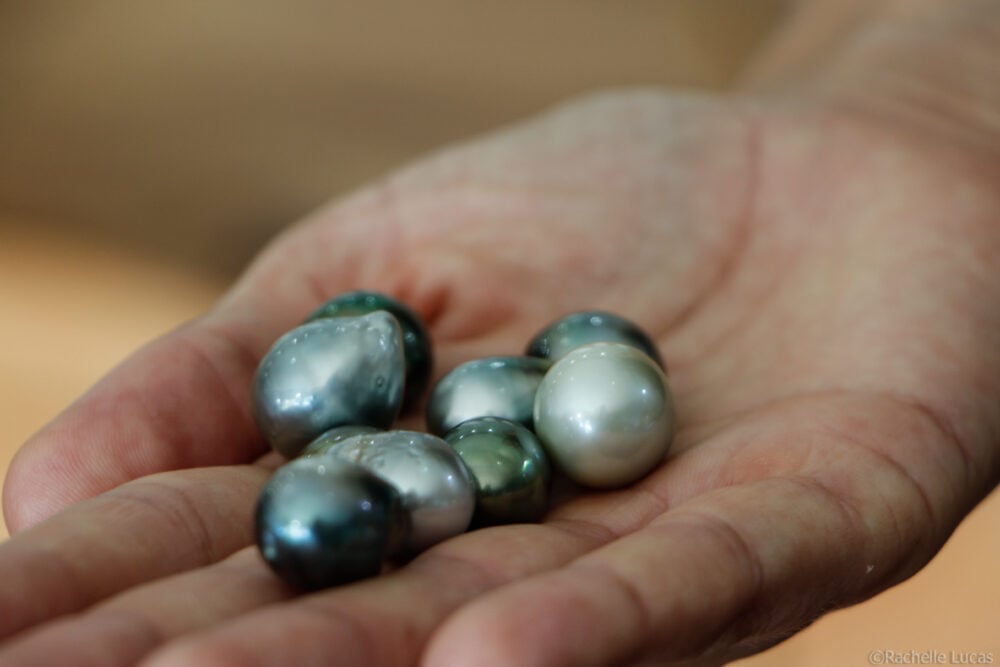
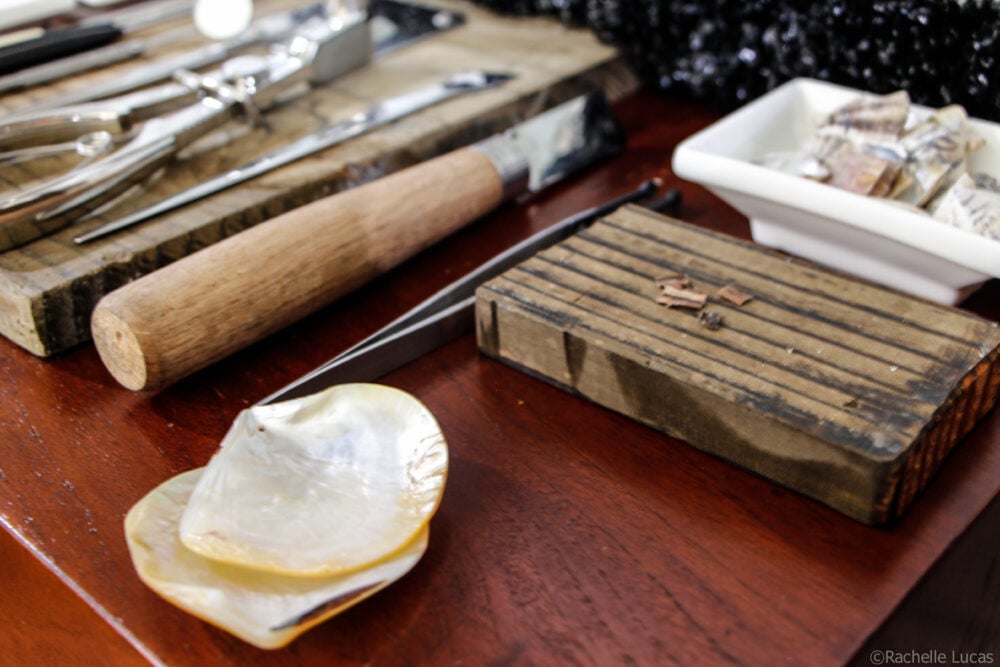
Also called Tahitian pearls, black pearls are produced by black-lipped oysters, which thrive in waters surrounding the French Polynesian islands, Including Bora Bora. Seeking to demystify the Tahitian black pearl, I spent some time with pearl expert Dominique Li-Oi Petra at The Black Pearl Lounge at Four Seasons Resort Bora Bora. The boutique — now known as the Tahitian Black Pearl Boutique and managed by jewelry designer Tahia Hering — is a sleek, VIP lounge-style space where guests can learn about pearl formation and browse a signature collection of rare Tahitian pearls.
Interview with Bora Bora Black Pearl Expert
Q: What makes Tahitian pearls special?
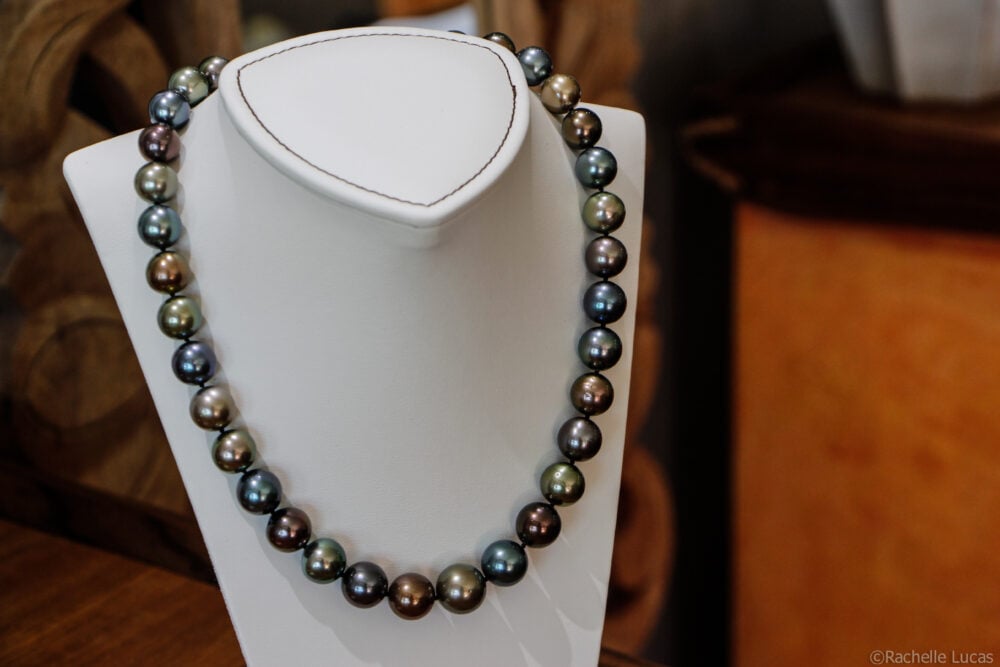
Dominique: They’re known for the wide range of colors that we offer including rare hues such as blue, pink, and green. They’re protected by law for their natural color and are GIA certified and guaranteed to be natural. Diamonds might have four value factors, but for black pearls, there are seven: size, shape, color, surface quality, luster, matching, and nacre.
Q: How do they develop their color? Are they all considered black pearls?
Dominique: Yes, they’re all black pearls and they develop their natural color from several factors, from the individual oyster to the water temperatures. What’s magic about the pearl is that it’s all mother nature’s decision.
Q: What can guests expect to experience at The Black Pearl Lounge?
Dominique: What is most important for us is to educate people. When they start loving the pearl and researching it online, they realize it’s not an expense, but an investment. There is a sort of communication of feeling and discovering the pearls that makes it a very sensual gem. You can get addicted to them!
After spending time with Dominique learning about the seven value factors and the magic behind each pearl’s unique color, I couldn’t leave empty-handed. I chose a single black pearl charm that I wear on a white gold chain. And to this day it remains one of my favorite travel souvenirs. Every time I wear it, it takes me straight back to Bora Bora. That’s the thing about Tahitian pearls: they’re not just jewelry, they’re a memory you can carry with you.

Bora Bora Black Pearls: A Buyer’s Guide
Shopping for black pearls in Bora Bora is an experience in itself — but knowing what to look for before you browse makes all the difference between a great investment and an impulse buy you’ll regret.
The Seven Value Factors
As pearl expert Dominique explained, unlike diamonds which are judged on four factors, Tahitian black pearls are evaluated on seven: size, shape, color, surface quality, luster, nacre thickness, and matching (for strands or pairs). The most important of these is luster — a high-quality pearl should appear to glow from within, not just reflect light off the surface.
Understanding Color
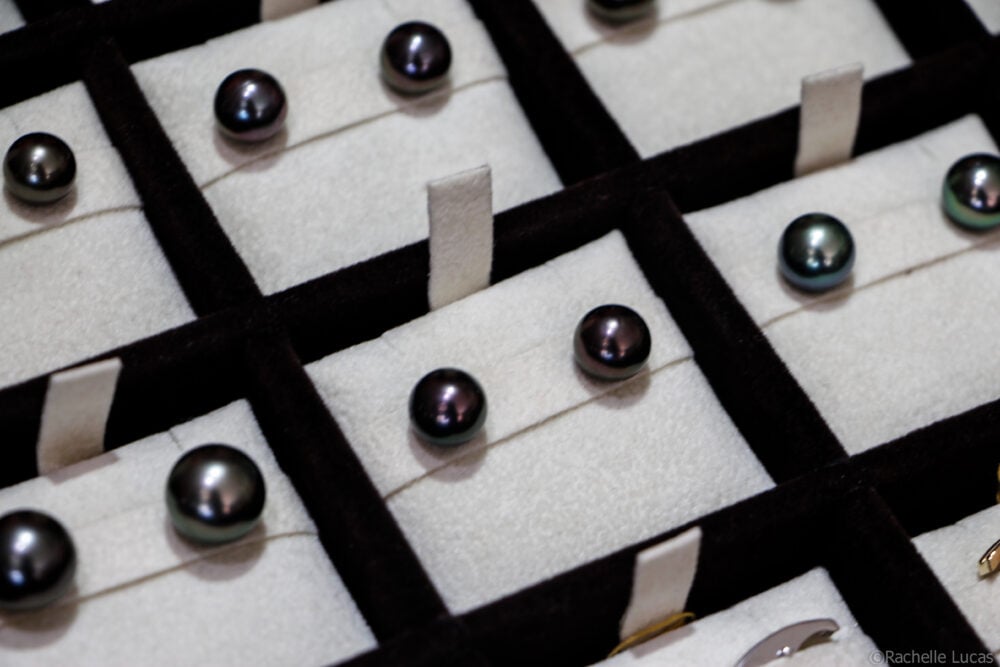
Despite being called “black” pearls, truly black Tahitian pearls are actually quite rare. Most range from charcoal grey and silver to deep green, blue, and aubergine. The most prized color is “peacock” — a dark green with pink or purple overtones — which commands the highest prices. Don’t be put off by pearls that aren’t jet black; the color variation is part of what makes each one unique.
Grades to Know
Tahitian pearls are graded from A to D, with the top tier sometimes labeled “Perfect” or “TOP GEM.” Grade A pearls have minor surface imperfections visible only under close inspection, while D grade pearls have significant blemishes. For jewelry you’ll wear regularly, a Grade A or B pearl offers the best balance of quality and value.
Price Ranges
A single loose Tahitian pearl typically starts around $50–$200 for lower grades, while high-quality round pearls in the 10–14mm range can run $500–$2,000 or more. Finished jewelry (rings, pendants, necklaces) varies widely. Expect to pay a premium at hotel boutiques like the Black Pearl Lounge at the Four Seasons; you’ll find more competitive pricing in Papeete on the main island of Tahiti if your itinerary allows.
Tips for Buying in Bora Bora
- Always ask for a certificate of authenticity stating “Tahitian Cultured Pearl” — this protects you from buying dyed freshwater pearls passed off as Tahitian.
- Visit more than one boutique before committing. Hotel shops are convenient but rarely the best price.
- Don’t be afraid to negotiate — a polite ask for a discount is standard practice in pearl boutiques throughout French Polynesia.
- Roll the pearl between your fingers — genuine nacre feels slightly gritty against your teeth (yes, the tooth test is real!), while imitations feel perfectly smooth.
- Buy what speaks to you — as Dominique said, each pearl’s color is entirely nature’s decision, making every one truly one of a kind.
Disclosure: This trip was part of an exciting work assignment for Four Seasons Magazine where I was invited on the inaugural flight for the Around The World Four Seasons Private Jet Experience.
Want to save this story for later? Pin it! 🙂

Breathtaking. I’m not a big pearl fan, but I do like black pearls. That’s what I wore on my wedding day. I could definitely get addicted!
The black pearls are certainly special in Tahiti/French Polynesia. In Moorea, we picked up a round mother-of-pearl pendant, with a small misshappen pearl bud glued on it. It was far less expensive than a black pearl necklace – but very pretty. And a nice momento for Janice of our visit 🙂